
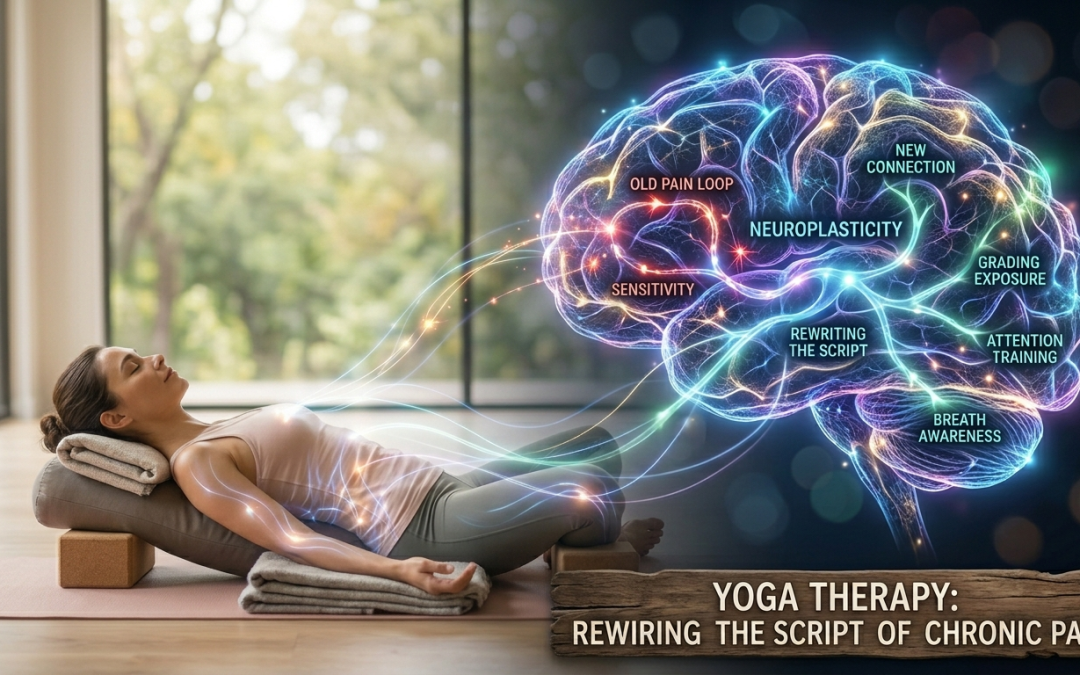
The Story of Your Nervous System: Rewriting the Script of Chronic Pain
Imagine a student walks into a yoga studio. Let’s call her Jennifer. Jennifer has been dealing with lower back pain for two years. Clinically, her tissues have healed; the MRIs are clear, and the physical therapist says her muscles are strong. Yet, every time she reaches for a yoga block or even thinks about a forward fold, a sharp, familiar ache blooms in her spine.
Jennifer isn’t “making it up,” and her body isn’t “broken.” She is caught in a story written by her nervous system—a process called neuroplasticity.
1. The Architect: Understanding Neuroplasticity
For a long time, we believed the brain was a fixed machine. We now know it’s more like a garden—constantly growing, pruning, and shifting. Neuroplasticity is the brain’s ability to reorganize itself based on experience.
The golden rule of the nervous system is: What fires together, wires together. In chronic pain, the brain becomes an overprotective parent. It learns to produce pain signals so efficiently that it creates a “pain loop,” even after the original injury has vanished. The good news? If the brain can learn pain, it can also unlearn it.
2. The Alarm System: Hurt vs. Harm
In the world of yoga therapy, we make a vital distinction: Hurt does not always equal Harm.
- Acute Pain: This is the “First Arrow.” You stub your toe; the body sends a signal, the brain evaluates the threat, and it produces pain to stop you from walking on a broken bone. It’s protective and short-term.
- Chronic Pain: This is pain that persists beyond the typical healing timeline (usually 3+ months). At this stage, the pain is no longer a “damage meter”—it’s a sensitized alarm system.
| Type | Description | Clinical Interpretation |
| Acute Pain | Short-term, protective, linked to injury. | Vital for survival; tells us to rest. |
| Chronic Pain | Persists beyond healing (3+ months). | Reflects nervous system sensitivity, not tissue damage. |
3. The Two Arrows: How We Amplify the Signal
Yoga philosophy gives us the perfect metaphor for the chronic pain cycle: The Two Arrows.
The First Arrow is the physical sensation itself—the throbbing or the tightness. The Second Arrow is our emotional and mental reaction: “Why is this happening again?” “I’ll never be able to hike again.” “My body is failing me.”
This mental reaction (fear, frustration, and catastrophizing) acts like fuel on a fire. It increases the “threat level” in the brain, which in turn produces more pain to protect you from that perceived threat. This creates a bidirectional loop where the mind and body keep each other in a state of high alert.
4. The Three Drivers of the Pain Cycle
Why does the brain keep the alarm ringing? Usually, it’s driven by three things:
- Emotional Response: Anxiety and fear strengthen the neural pathways of pain.
- Heightened Awareness: The more we “check in” on the pain, the more the brain prioritizes that signal. It’s like noticing a specific car everywhere once you decide you want to buy one.
- Protective Output: The brain restricts your movement (muscle guarding) because it thinks it’s keeping you safe.
5. Retraining the Brain: The Yoga Therapy Path
Yoga therapy doesn’t just “stretch muscles”; it retrains the nervous system. We use a variety of tools to interrupt the chronic pain cycle and foster neuroplasticity.
- Pain Education: Simply understanding that “hurt ≠ harm” reduces the threat level in the amygdala (the brain’s fear center).
- Graded Exposure: We don’t jump into a headstand. We start by visualizing a movement, then doing it gently, rebuilding the brain’s trust in the body.
- Pacing: We avoid the “Boom-Bust” cycle. Instead of doing 100% until we crash, we work at 50% capacity and gradually increase, teaching the brain that movement is safe.
- Awareness Training: We use the breath as an anchor. When pain arises, we acknowledge it without judgment and gently redirect our focus, strengthening the prefrontal cortex’s control over emotional reactivity.
6. Supporting the Change: Lifestyle and Nutrition
To rewrite the story of pain, the “soil” of the brain needs to be fertile. We support neuroplasticity through:
- Nutrition: Anti-inflammatory foods like Omega-3s, turmeric, and antioxidants support the production of BDNF (Brain-Derived Neurotrophic Factor)—the “miracle-gro” for new neural connections.
- Patience: Neural changes take time.
- 1–2 weeks: Initial shifts in perception.
- 4–8 weeks: Noticeable changes in movement patterns.
- 3–6 months: Significant rewiring of the nervous system.
7. Integrating the Practice
Yoga therapy bridges the gap between the physical and the neurological. Through Pranayama (breathing) to calm the nerves, Asana (mindful movement) to rebuild trust, and Yoga Nidra (deep relaxation) to downregulate the stress response, we begin to blur the distorted “brain maps” of pain and replace them with maps of clarity and ease.
The Takeaway: Your pain is real, but it is not a life sentence. Through consistency, compassion, and the science of yoga, you can teach your brain a new way to inhabit your body.