
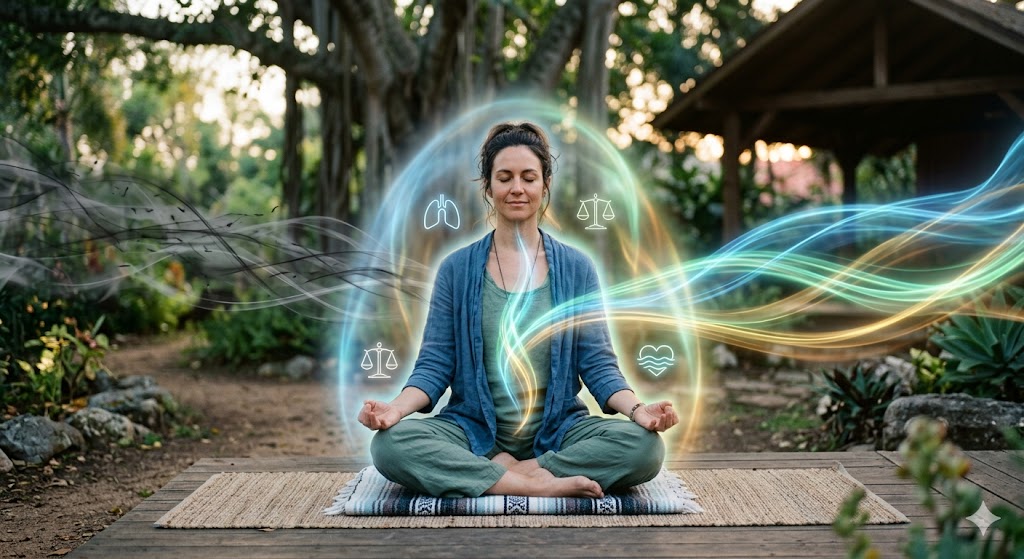
We have all experienced that specific kind of “soul-tired”—the exhaustion that a full night’s sleep cannot touch. This isn’t just physical fatigue; it is a state of mental and emotional bankruptcy.
Recently, while studying with Dr. Atul Pednekar at The Yoga Institute, I was introduced to a powerful practice called Emo-Energy Balancing. While it is rooted in the broader tradition of Yoga Psychology, Emo-Energy Balancing is the applied aspect—the practical toolkit that translates ancient wisdom into a daily practice for ending the cycle of depletion.
The core objective is simple yet profound: Restructuring your Perspective. We aren’t just trying to “feel better” in the moment; we are systematically changing how the mind processes reality to halt chronic exhaustion at its source.
What Is Yoga Psychology?
To understand Emo-Energy Balancing, we must first understand the system it emerges from: Yoga Psychology.
In the West, Yoga is often reduced to physical postures. In the clinical tradition, however, Yoga Psychology is a rigorous science that treats Prana (life-force energy) with precision. It provides the theoretical map of the mind—and Emo-Energy Balancing is the practice that helps you navigate that map.
Definition:
Yoga Psychology is the systematic study of the mind (Citta), its various states (Bhumi), and its modifications (Vrittis). It focuses on the regulation of mental processes to achieve a state of emotional equilibrium and self-realization.
— Reference: The Yoga Institute, Santacruz.
Think of Yoga Psychology as the “anatomy” of your inner world. It explains how the mind works, why we get stuck in patterns of depletion, and what the pathways to freedom look like. Emo-Energy Balancing is the “physiology”—the living, breathing application of that knowledge.
In this integrated view, “energy” refers to your actual biopsychological resources. When you are chronically depleted, it is because your mental “circuitry” is running high-resistance patterns—rumination, judgment, or suppressed emotion. Yoga Psychology identifies these patterns, and Emo-Energy Balancing gives you the tools to rewire them.
Emo-Energy Balancing: Core Techniques
At the heart of Emo-Energy Balancing are numerous techniques drawn from the rich tradition of Yoga Psychology. Among them, the Bhavas (Attitudes) form a foundational set of cognitive tools that allow you to move from being a victim of your circumstances to becoming a conscious manager of your internal resources.
While Emo-Energy Balancing encompasses many more practices—including breath awareness (pranayama), mantra, self-inquiry (svadhyaya), and guided meditation—the following four techniques serve as an accessible entry point into this transformative system. They are pillars precisely because they are essential, but they are not the whole structure. There is much more to explore.
Technique 1: Nishpanda Bhava – The Unmoving Observer
This is the practice of creating internal silence. Instead of getting swept up in the noise of a stressful situation, you cultivate a state of unmoving observation.
- The Practice: Witness an event or a surge of emotion without moving toward it (attachment) or away from it (aversion). You become the “eye of the storm.”
- The Energy Win: You stop the “friction” caused by immediate mental reactivity, preserving the Prana that is usually wasted on knee-jerk impulses. This is Yoga Psychology’s principle of witness consciousness applied in real time.
Technique 2: Pratipaksha Bhavana – The Strategic Pivot
When a draining thought takes hold, Emo-Energy Balancing teaches us not to “resist” it—resistance itself costs energy. Instead, we practice cultivating a counter-thought.
- The Practice: If the mind says, “This is a disaster,” you deliberately introduce a neutral, factual counter-frame: “This is a complex challenge that I am currently navigating step-by-step.”
- The Energy Win: This reframing neutralizes the stress response (cortisol spike) before it can drain your battery. In Yoga Psychology, this is the practice of redirecting Vrittis (mental modifications) toward equilibrium.
Technique 3: Anitya Bhavana – The Science of Impermanence
This is the practice of reflecting on the impermanent nature of all phenomena—a cornerstone of Yoga Psychology’s understanding of suffering.
- The Practice: Recognizing that the current “crisis”—the traffic, the difficult email, the physical discomfort—is a temporary state in a world of constant flux.
- The Energy Win: It provides an immediate “zoom-out” perspective. By realizing “this too shall pass,” the mind stops over-investing energy in a passing moment. Emo-Energy Balancing uses this insight to prevent emotional spirals.
Technique 4: Energy Exchange Awareness
Yoga Psychology teaches that every human interaction is a form of energy exchange. Emo-Energy Balancing brings this awareness into sharp focus.
- The Practice: Identifying the flow of a conversation in real-time. Is this exchange nourishing or depleting? Are you taking on someone else’s emotional load out of habit?
- The Energy Win: You begin to set energy boundaries, treating your attention as a finite, valuable currency that must be spent wisely. This is Yoga Psychology applied to relationships.
These four techniques are a starting point—a foundation upon which a deeper practice can be built. Emo-Energy Balancing offers many more tools, each suited to different temperaments, challenges, and stages of the journey.
The Cycle of Depletion: A Yoga Psychology Perspective
In Yoga Psychology, depletion is not random—it is a mechanical, predictable process. Without awareness, the mind follows a high-cost loop that functions like a leak in a pressurized system:
- The Event: A neutral stimulus occurs (e.g., a colleague’s short tone).
- The Glitch (Vritti): Your mind adds a “story” or interpretation (e.g., “They don’t respect my work”).
- The Response: A spike in emotional reactivity and physiological stress.
- The Result: Total energy depletion.
Emo-Energy Balancing interrupts this loop. By applying techniques such as the four Bhavas above—along with other practices like breath regulation, mantra repetition, and structured self-inquiry—we break the chain:
- We see the event without reactivity (Nishpanda).
- We recognize its transience (Anitya).
- We swap the draining story for a neutral counter-frame (Pratipaksha).
- We monitor the exchange of energy in the interaction.
Where Yoga Psychology provides the diagnosis, Emo-Energy Balancing provides a comprehensive toolkit for treatment—far more extensive than any single set of techniques.
Expanding Your Energy: A Path Forward
If you are reading this and recognizing your own experience in these words—if you feel the weight of chronic depletion and sense that there must be another way—you are not alone.
Emo-Energy Balancing is not just a concept to understand; it is a practice to embody. And like any practice, it requires guidance, repetition, and a willingness to turn inward with curiosity rather than judgment.
For those who are interested in truly learning how Emo-Energy works—not just intellectually, but experientially—there is an opportunity to go deeper. This work is about two interconnected goals:
- Expanding Your Energy: Moving beyond mere survival into a state where your internal resources are abundant, resilient, and sustainable. It is about cultivating a reservoir of Prana that supports you through life’s challenges rather than being depleted by them.
- Stopping Depletion: Learning to identify and dismantle the unconscious patterns—the mental “leaks”—that drain your energy before you even realize it is happening. This is not about adding more to your to-do list; it is about removing what is unnecessary so that your natural vitality can return.
When you understand the mechanics of your own energy system—how it gets depleted, how it can be restored, and how it can be expanded—you reclaim sovereignty over your inner life. You stop being at the mercy of external circumstances and begin to move through the world from a place of stability, clarity, and choice.
Final Reflection: The Invitation
Yoga Psychology gives us a profound truth: energy is not an infinite resource; it is a biological currency that must be managed with intention. Emo-Energy Balancing is the daily practice that puts that truth into action.
When you understand the mind through the lens of Yoga Psychology and apply the tools of Emo-Energy Balancing, you stop blaming the external world for your exhaustion. You recognize depletion as a pattern—and patterns can be rewired.
This is the essence of the work: restructuring your perspective so that inner balance is no longer elusive. It is not just a “vibe” or a momentary escape. It is a deliberate, scientific choice to stay anchored in your own center.
From this space—where the wisdom of Yoga Psychology meets the practical application of Emo-Energy Balancing—you don’t just survive your day. You move through it with sustained, balanced vitality.
If you are interested in learning how Emo-Energy Balancing works—and, more importantly, how to stop depleting your own energy while learning to expand it—I invite you to reach out.
Whether you are a yoga practitioner, a therapist, or someone simply seeking a way out of chronic exhaustion, this work offers a structured, compassionate path forward. Together, we can explore the full spectrum of techniques that Emo-Energy Balancing offers—far beyond just the four foundational practices shared here—and put them into practice in your own life.
Your energy is not meant to be spent until empty. It is meant to be cultivated, conserved, and expanded. Let this be the moment you begin.