
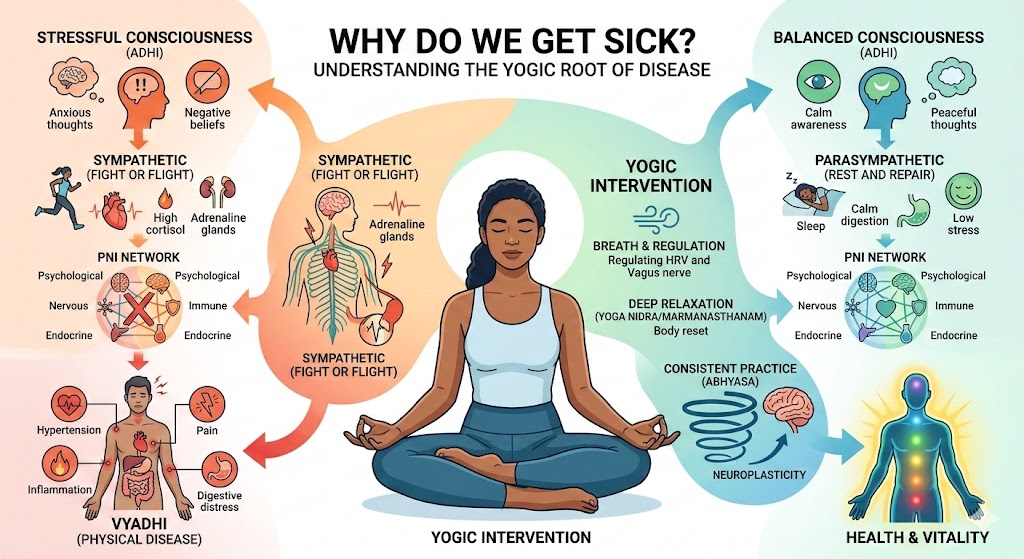
Understanding the Yogic Root of Disease
Many people begin their health journey when something in the body stops working the way it used to. Perhaps pain does not go away, sleep becomes difficult, digestion feels unpredictable, or stress seems to stay in the body long after the day has ended.
Medical tests may reveal a diagnosis—hypertension, chronic pain, digestive disorders, fatigue, or anxiety. Modern medicine provides powerful tools to diagnose disease and stabilize the body. These treatments are essential and have saved countless lives.
Yet many people eventually ask a deeper question:
Why did this happen in the first place?
Yoga therapy explores this deeper layer of health.
Rather than focusing only on symptoms, yoga views the human being as a deeply interconnected system of body, breath, mind, and awareness. Over time, chronic stress, emotional tension, and lifestyle imbalance can influence the nervous system and gradually affect physiology.
From this perspective, illness is often not a sudden event. It is the final stage of a longer process that develops quietly over time.
Understanding this process helps us work more effectively with both modern medical care and yoga therapy—treating the condition while also restoring balance in the systems that influence long-term health.
A Practical Example: When Life Patterns Affect the Body
Imagine someone who has spent many years suppressing anger or frustration. They may feel stuck in a job they do not enjoy, experience constant pressure, or struggle to express emotions openly.
Over time, certain patterns begin to develop:
- chronic psychological stress
- shallow or restricted breathing
- poor sleep quality
- persistent activation of the stress response
- repetitive thought patterns that increase tension rather than resolve it
Eventually, this person is diagnosed with hypertension.
From a medical perspective, the physician may prescribe medication that safely lowers blood pressure and protects the heart and blood vessels. This medical treatment is essential.
From a yoga therapy perspective, however, the diagnosis also invites us to examine the patterns that may have contributed to the condition.
These might include:
- long-term emotional suppression
- dysregulated breathing patterns
- chronic sympathetic nervous system activation
- lack of restorative rest
- mental habits such as worry or internal pressure
A therapeutic yoga program may include gentle movement, breathing practices, guided relaxation, and self-awareness practices. Over time, these tools help regulate the nervous system and reduce the physiological drivers of chronic stress.
In this way, yoga therapy works alongside medical care, supporting long-term healing.
The Yogic Model of Disease: Adhi and Vyadhi
Ancient yogic teachings, particularly the Yoga Vasistha, describe a two-stage process in the development of many chronic illnesses.
Adhi – The Mental Origin
The first stage is Adhi, disturbances that begin in the mind.
These disturbances may include:
- chronic stress
- emotional conflicts
- unresolved fears or anxieties
- lifestyle patterns that conflict with our inner values
According to yogic philosophy, these imbalances arise in the Manomaya Kosha, the mental and emotional layer of our being.
Vyadhi – The Physical Expression
If these disturbances persist over time, they gradually begin to influence the body’s physiology. Eventually they may manifest in the Annamaya Kosha, the physical body, appearing as symptoms or disease.
The yogic insight is simple yet profound:
Many chronic conditions begin long before symptoms appear in the body.
This does not suggest that illness is “all in the mind.” Rather, it recognizes that mind and body constantly influence each other.
Modern Science and the Mind–Body Connection
Modern research supports this interconnected view through the field of Psychoneuroimmunology (PNI).
PNI studies how thoughts and emotions influence the nervous system, immune system, and hormonal regulation.
Research by neuroscientist Candace Pert demonstrated that emotions are translated into chemical messengers called neuropeptides. These molecules circulate throughout the body, allowing our mental and emotional states to influence cellular activity.
PNI shows that four major systems are constantly communicating:
- Psychological system – thoughts and emotions
- Nervous system – brain and nerve signaling
- Endocrine system – hormones such as cortisol and adrenaline
- Immune system – the body’s defense and healing network
For example, prolonged psychological stress can activate the body’s stress response and elevate cortisol levels. Over time this can disrupt sleep, digestion, immune resilience, and metabolic balance.
In this way, modern science increasingly validates the ancient yogic understanding of the mind–body connection.
The Nervous System: A Key Regulator of Health
One of the most important systems involved in health and disease is the autonomic nervous system.
This system has two major branches.
Sympathetic Nervous System – Mobilization
Often referred to as the fight-or-flight response, the sympathetic system prepares the body for action. It increases heart rate, muscle tension, and alertness.
This response is vital for survival. However, when it becomes chronically activated, it can contribute to many stress-related health problems.
Parasympathetic Nervous System – Restoration
The parasympathetic state is sometimes called rest and digest. In this state the body focuses on:
- tissue repair
- digestion and nutrient absorption
- immune regulation
- hormonal balance
- restoration of energy
Modern neuroscience, including the work of Stephen Porges and his Polyvagal Theory, shows that chronic stress can keep the nervous system locked in defensive states.
When this happens, the systems responsible for healing and recovery become less active.
Many yoga practices—particularly breathing exercises, relaxation techniques, and meditation—stimulate the vagus nerve and help the body shift toward the parasympathetic healing state.
Yoga Psychology: Repatterning the Mind
While physical postures support the body, classical yoga also offers tools for transforming mental patterns.
The teachings of the Yoga Sutras of Patanjali describe how deeply embedded habits of thought—called samskaras—shape our reactions to life.
These patterns may appear as:
- perfectionism
- chronic worry
- emotional reactivity
- persistent self-criticism
Through Svadhyaya (self-study), we begin to observe these patterns more clearly.
Modern neuroscience describes a similar process through neuroplasticity, the brain’s ability to reorganize itself through experience.
Research shows that meditation and contemplative practices can reduce activity in the amygdala (the brain’s fear center) while strengthening the prefrontal cortex, which supports emotional regulation and balanced decision-making.
Through consistent practice, yoga helps reshape both mental habits and neural pathways.
How Yoga Therapy Supports Healing
Yoga therapy supports health by influencing both physiology and consciousness. It complements medical treatment by helping regulate the systems that affect recovery.
Some of the most powerful tools include:
Breath Regulation
Slow, rhythmic breathing can activate the vagus nerve and improve heart rate variability (HRV)—an important marker of nervous system resilience.
Deep Relaxation
Practices such as Yoga Nidra guide the body into deep states of rest where the nervous system can reset and cellular repair can occur.
Consistent Practice (Abhyasa)
Regular practice gradually rewires neural pathways. Over time, calm regulation becomes easier and more natural.
Modern Medicine and Yoga Therapy: Working Together
Modern medicine and yoga therapy serve different but complementary roles.
Modern medicine excels at:
- diagnosing disease
- managing acute conditions
- performing life-saving interventions
- prescribing medications or surgery when necessary
Yoga therapy contributes by:
- reducing chronic stress patterns
- improving nervous system regulation
- supporting immune and hormonal balance
- strengthening self-awareness and healthy lifestyle habits
When these approaches work together, they address both immediate symptoms and the deeper patterns that influence long-term health.
A Holistic View of Healing
From the yogic perspective, health is not simply the absence of disease. It is a state of harmony between body, breath, mind, and awareness.
Modern research increasingly confirms that our thoughts, emotions, nervous system, hormones, and immune function are deeply interconnected.
By integrating the strengths of modern medicine with the self-regulatory practices of yoga, we gain a more complete pathway toward healing and well-being.

References and Further Reading
Research & Science
- Ader, R. (2001). Psychoneuroimmunology. Academic Press.
- Pert, C. B. (1997). Molecules of Emotion: The Science Behind Mind-Body Medicine. Scribner.
- Porges, S. W. (2011). The Polyvagal Theory: Neurophysiological Foundations of Emotions, Attachment, Communication, and Self-Regulation. W.W. Norton.
- Streeter, C. C., et al. (2012). “Effects of Yoga on the Autonomic Nervous System, Gamma-Aminobutyric Acid, and Allostasis in Epilepsy, Depression, and PTSD.” Medical Hypotheses.
Books & Classical Texts
Van der Kolk, B. (2014). The Body Keeps the Score: Brain, Mind, and Body in the Healing of Trauma. Penguin Books.
Satyananda Saraswati (2001). Yoga Nidra. Yoga Publications Trust.
Swami Satchidananda (Trans.). The Yoga Sutras of Patanjali. Integral Yoga Publications.
Swami Venkatesananda (Trans.). The Concise Yoga Vasistha. SUNY Press.