
In 2025, Narayani’s Yoga Therapy returned to a simple but often overlooked truth:
how we breathe, how we support our core, and how we hold ourselves in space are inseparable pillars of lived health.
This year’s theme was re-integration—helping people move out of fragmentation, chronic tension, and shallow breathing, and into coherence: a body that supports life rather than resists it.
Posture is often reduced to “standing tall.”
Breathing is often reduced to “air moving in and out.”
Yet beneath the surface, posture and breathing are governed by the same intelligent system: the deep core. When this system is understood and restored, alignment becomes natural, movement becomes efficient, and the body regains resilience.
The Deep Core: More Than Abs
The “core” is frequently mistaken for surface abdominal strength. In reality, it is a coordinated, three-dimensional support system that stabilizes the spine, pelvis, and ribcage.
Its primary components include:
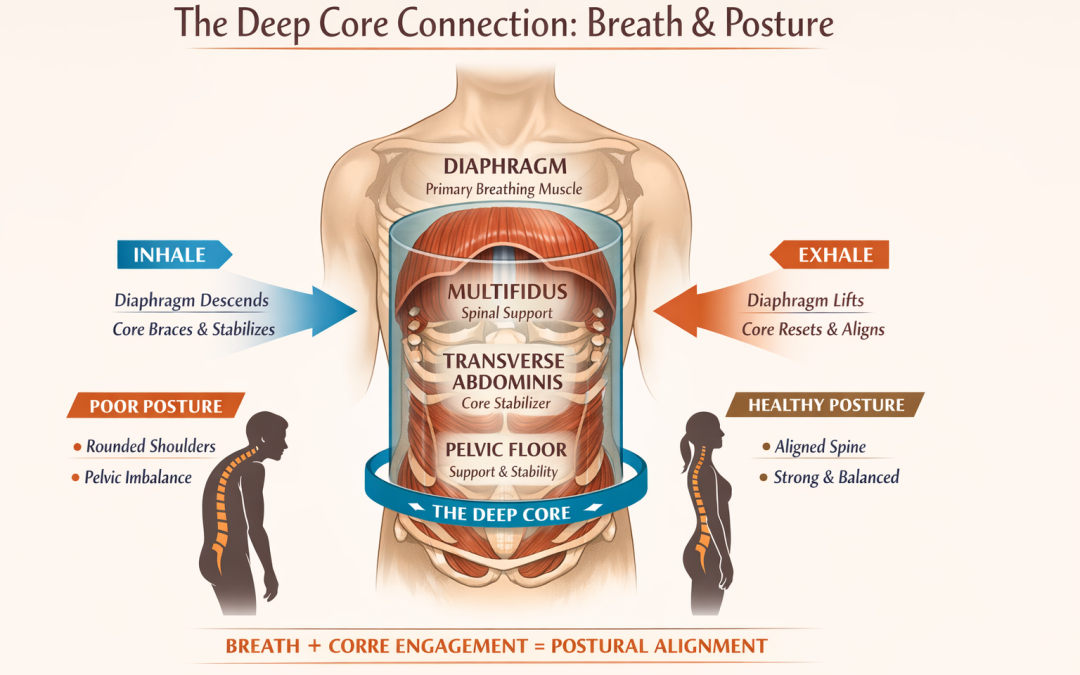
- Diaphragm – the primary muscle of breathing, forming the roof of the core
- Transverse Abdominis (TVA) – a deep, corset-like muscle that provides internal support
- Pelvic Floor Muscles – forming the base of the core and regulating pressure and support
- Multifidus – small but vital spinal stabilizers supporting each vertebra
Together, these muscles function as a dynamic cylinder. They protect the spine, support the organs, and allow the body to move with efficiency rather than effort.
Breathing Is a Postural Act
Breathing is not separate from posture—it actively shapes it.
- The diaphragm as a stabilizer:
During inhalation, the diaphragm descends, increasing intra-abdominal pressure. This pressure gently engages the TVA and pelvic floor, creating natural spinal support. - The role of exhalation:
A slow, controlled exhale allows the diaphragm to rise, the core to reset, and the spine to decompress. When breathing becomes shallow and chest-dominant, tension often accumulates in the neck, shoulders, and lower back.
Each breath becomes a subtle training moment for the deep core—either reinforcing stability or feeding dysfunction.
Posture Reflects Breathing Patterns
The body organizes itself around how it breathes.
Common patterns linked to dysfunctional breathing include:
- Rounded shoulders from overuse of accessory breathing muscles
- Pelvic imbalance and lower-back strain from insufficient core coordination
- Neck tension and forward head posture as the body compensates for diaphragmatic inefficiency
When breathing expands into the belly, lower ribs, and back body, the deep core responds automatically. Upright posture becomes less about “holding” and more about support from within.
Narayani’s Deep Work in 2025
Throughout 2025, Narayani’s Yoga Therapy focused on restoring authentic diaphragmatic movement and repatterning cortical and nervous system responses.
This was not surface correction, but deep retraining—teaching the nervous system to coordinate breath, core engagement, and posture seamlessly. The result was not forced alignment, but sustainable changes in stability, ease, and overall well-being.
The Takeaway
Breathing, posture, and the deep core cannot be separated.
When the core is uncoordinated, posture collapses and breath becomes shallow.
When breathing is inefficient, postural strain and tension follow.
Rebuilding this relationship does more than improve alignment—it cultivates calm, resilience, and efficient movement that carries into daily life.
The 2025 theme of Narayani’s Yoga Therapy was simple and profound:
re-integration through breath, core, and posture—one breath at a time.